Showing posts with label DSLR. Show all posts

Tuesday, March 24, 2009

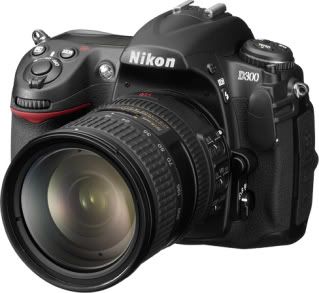
Nikon D300 user review


Nikon's D300 is a photographer's camera. There are no Scene modes, not even a Green Auto mode to make the camera do it all for you. As such, the flash doesn't have a mode where it pops up automatically. But if you know what you're doing, there's plenty that the Nikon D300 will do for you. It'll adjust your ISO, find detail in the shadows, and track your subject even when it's not in the autofocus area.

There are a few limitations to what it can do compared to what we heard when the Nikon D300 was first announced. For example, though it has 14-bit A/D conversion available in RAW mode for significantly more color information in each image file, the frame rate slows down from 6.13 frames per second in 12-bit mode to 2.66 seconds in 14-bit mode. That doesn't happen with the D3, nor the Canon 40D (though the 40D is only 10 megapixels instead of the D300's 12.3). And though the Nikon D300 has 51 autofocus points like the Nikon D3, it is much slower at acquiring focus than the D3 is when in Auto-area AF. It's also slower than the competition, whose AF includes considerably fewer points.
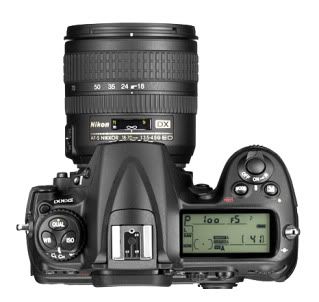
But these aren't reasons to discount the Nikon D300, which is one of the most capable and well-designed digital SLRs made. Like the D200 did, the Nikon D300 continually surprises me. When I encounter a new situation that requires a new setting or mode, I just take a look at the back and top of the D300 and usually find my answer readily available. Granted, in the beginning there were a few times when I just decided to make do with other settings rather than delve into the comprehensive menu system. Later I found the solution after a little investigation, but it's clear that there's a bit of learning curve to using the Nikon D300. Indeed, the Nikon D300's manual is almost twice as thick, with just over double the pages of the D200's: 421 pages compared to 210.

I'll try to hit on a lot of the Nikon D300's major points, but this is just the User Report, so there's not as much room or time as this significant digital SLR camera deserves. For more of the in-depth detail, see the many tabs and sub-tabs which include pages of detail and analysis. We've taken hundreds of shots with the Nikon D300, and you're welcome to download, tweak, and print any of them for your own individual camera research purposes.
by Shawn Barnett

credit to : imaging resource

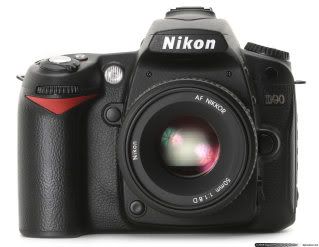
Nikon D90 review


*Review based on a production Nikon D90 with firmware V1.0

Almost exactly two years after the D80 was announced comes its replacement, the rather predictably named D90. The D80 has been one of Nikon's quiet successes, and even today, despite being positively Methuselah-like in digital camera terms it continues to sell and often makes its way into our top 10 most clicked on cameras. Because it looks so similar to the D80 the D90 appears at first glance to be one of those rather subdued incremental upgrades, but dig a little deeper and you'll find there's plenty to keep Nikon fans happy.

First and foremost there's a new CMOS sensor, which Nikon claim produces D300 quality output at up to ISO 6400 and - one of several features to 'trickle down' from higher models - the same highly acclaimed 3.0-inch VGA screen as the D3/D300. Naturally it has Live View with contrast-detect AF and it would have been surprising had it not sported some form of dust removal system. More surprising is the inclusion of the world's first DSLR movie mode (720p HDTV quality, no less) and HDMI output, though as we'll see later it does come with some limitations. A lot of the core photographic spec is the same as or very similar to the D80, though there is a new shutter and an implementation of the 3D tracking AF seen on the D3/D300.

And it's not just the high end models that have lent features and technology to the D90; the user interface has been given the same user-friendly treatment as the D60, as have the retouching options. As it was explained to us the D90 is intended to appeal to the broadest audience of any Nikon SLR, from first-time 'step up' customers moving from a compact to serious amateurs wanting comprehensive photographic control without the cost and weight of a D300. Whether the D90 is as capable as its feature set suggests, we'll see as the review unfolds.
Nikon D90 Key Features
  • 12.9 megapixel DX-format CMOS sensor (effective pixels: 12.3 million)
  • 3.0-inch 920,000 pixel (VGA x 3 colors) TFT-LCD (same as D3 and D300)
  • Live View with contrast-detect AF, face detection
  • Image sensor cleaning (sensor shake)
  • Illuminated focus points
  • Movie capture at up to 1280 x 720 (720p) 24 fps with mono sound
  • IS0 200-3200 range (100-6400 expanded)
  • 4.5 frames per second continuous shooting (buffer: 7 RAW, 25 JPEG fine, 100 JPEG Normal)
  • Expeed image processing engine
  • 3D tracking AF (11 point)
  • Short startup time, viewfinder blackout and shutter lag
  • Slightly improved viewfinder (96% frame coverage)
  • Extensive in-camera retouching including raw development and straightening
  • Improved user interface
  • New optional compact GPS unit (fits on hot shoe)
  • Same battery and vertical grip as D80
  • Vignetting control in-camera
  • 72 thumbnail and calendar view in playback
credit to : dpreview

Sunday, November 30, 2008

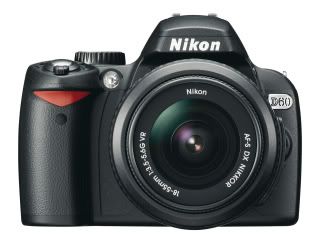
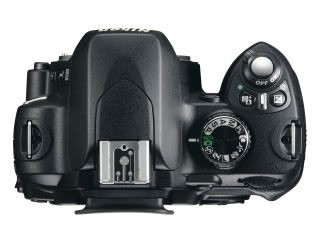
Nikon announces D60

The Nikon D60 is designed to simplify camera operation and allow the photographer to concentrate on taking pictures. The camera’s simple, user-friendly design includes a reduced number of buttons and a combined monitor and information display. A 2.5-inch LCD screen presents information using an easy to understand graphic user interface, with three types of presentation style to suit all users. The symbols and numbers in the display rotate through 90 degrees, presenting information in the correct orientation according to how the camera is being held. The D60 also includes a new feature that turns off the LCD monitor screen automatically when the viewfinder is in use.

The D60 utilizes Nikon’s exclusive EXPEED technology to maximize image quality and processing speed. The camera also offers creative features that are designed to allow the optimisation and adjustment of images without the need for a computer. Image optimisation is achieved through functions like Active D-Lighting (which compensates for strong shadows), and the automatic correction of false eye colour when using the built-in flash. Creative features include the automated creation of stop-motion animation files from a sequence of images, and effects that simulate the use of optical filters to produce colour shading and sparkling highlights.

To combat the dust that can be introduced into the camera body when changing lenses, , the D60 includes an integrated dust reduction system. Nikon’s exclusive Airflow Control System channels dust out of the image path and a vibrating, self-cleaning sensor unit shakes off any remaining dust from the camera’s optics.

The D60 is capable of use in a range of lighting conditions due to a wide sensitivity range of ISO 100 to ISO 1600 and offers vivid colour reproduction with clear, sharp results.. For convenient use in places where flash photography is not allowed, the camera will set the sensitivity automatically for the best results . The camera’s built-in Speedlight produces excellent balanced results thanks to Nikon’s sophisticated i-TTL flash system, and also allows the use of additional remote-controlled Speedlights.

SOURCE : dpreview